Can You Wear a Hearing Aid with Glasses Comfortably?
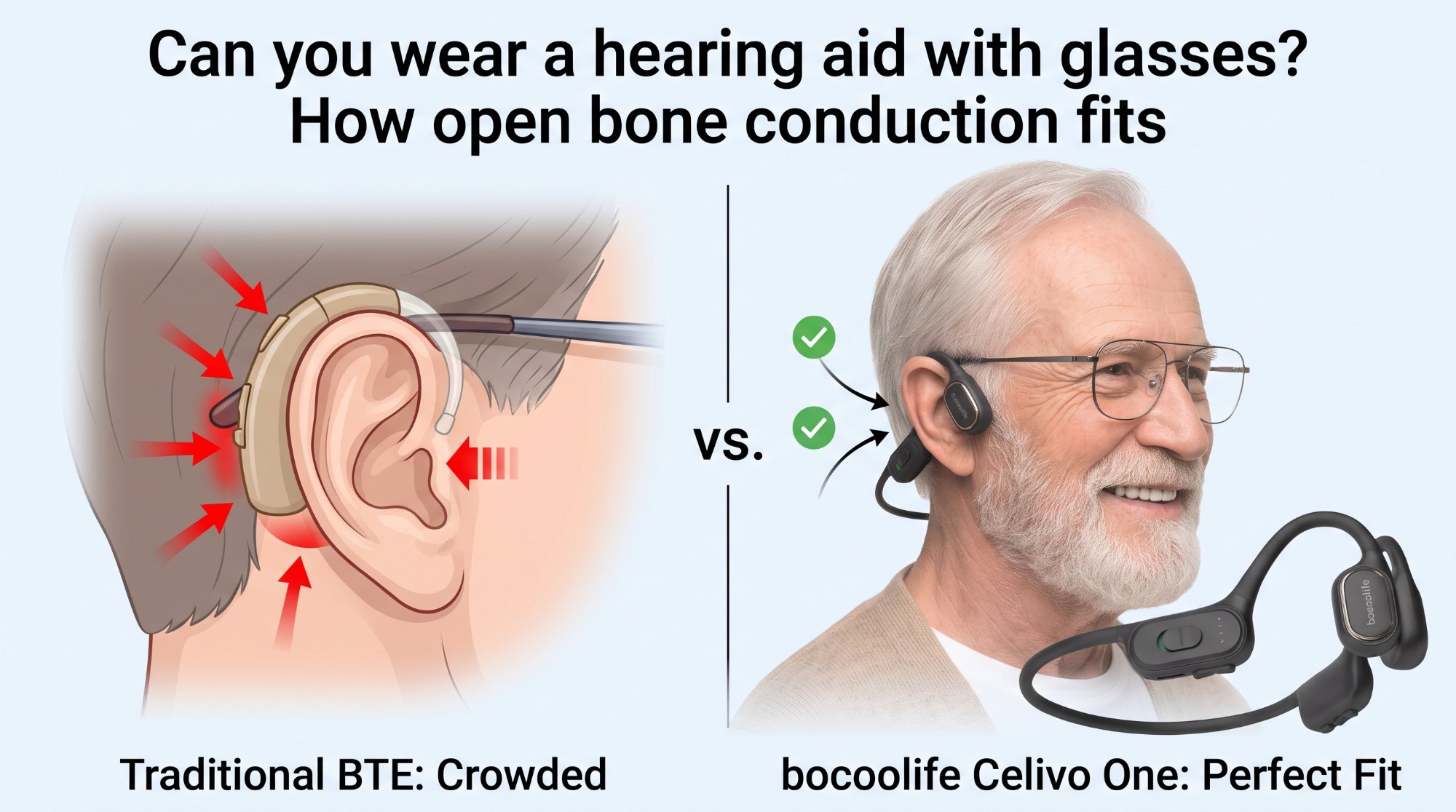
Can you wear a hearing aid with glasses without painful pinching behind your ears? Yes, an open-ear bone conduction hearing assistant like the bocoolife Celivo One can be worn alongside eyeglasses because your ear canal remains completely open. Rather than cramming into the ear canal, the device rests securely against your cheekbones. However, physical comfort depends on your individual ear shape, head contour, and glasses temple thickness, meaning individual fit can vary.
The Common Struggle: Eyeglasses and Behind-the-Ear Devices
For millions of adults who rely on prescription eyewear or reading glasses, adding a traditional behind-the-ear (BTE) hearing device creates daily friction:
- Behind-the-Ear Congestion: Standard BTE devices and glasses temples compete for the exact same narrow space above and behind your ear cartilage.
- Accidental Displacement: Taking your glasses off to read a menu or clean your lenses often catches the hearing aid wire, pulling the ear tip out or knocking the device loose.
- Friction and Soreness: When thick acetate frames press directly against an electronic housing, continuous pressure against the skull can lead to tenderness after hours of wear.
How Open-Ear Bone Conduction Modifies the Fit
An open-ear bone conduction hearing assistant changes how equipment interacts with your head anatomy.
Instead of routing sound tubes down the canal, the bocoolife Celivo One transmits acoustic vibrations through the cheekbone to the inner ear:
- Unblocked Ear Canals: Because nothing is inserted into your ear canal, your ears retain complete natural airflow, avoiding the warm, trapped feeling common when wearing multiple accessories.
- Separated Contact Areas: The acoustic transducers rest gently on the cheekbone in front of the ear, while the lightweight neckband wraps around the back of the head. This distributes contact across different anatomical zones rather than concentrating all weight behind the ear.
- Situational Freedom: Your ear canals remain unobstructed, allowing you to hear ambient sounds and conversation simultaneously while keeping your eyewear stable.
Best Practices for Wearing Bone Conduction with Eyeglasses
While bone conduction avoids the ear canal entirely, comfort is influenced by how you position both items:
- Put Glasses on First: Place your eyeglasses comfortably on the bridge of your nose and align the temples along your temples.
- Position the Headset Second: Rest the bone conduction transducers on your cheekbones just forward of your ears, letting the lightweight arms settle over your eyeglass stems.
- Consider Your Frame Style: Thin metal or titanium wire temples generally offer the smoothest experience, creating minimal surface area for the headset to touch. Thicker plastic frames may require minor position adjustments.
Understanding Individual Fit
Physical comfort is subjective and unique to every person's anatomy. The distance between your ear and cheekbone, cranial curvature, and the width of your glasses all influence the final feel.
While open-ear bone conduction eliminates the canal-plugging discomfort of conventional devices, taking a few days to adjust placement ensures you find the most natural balance for daily conversation.