What Is the Difference Between Bone Conduction and Behind-the-Ear Devices?
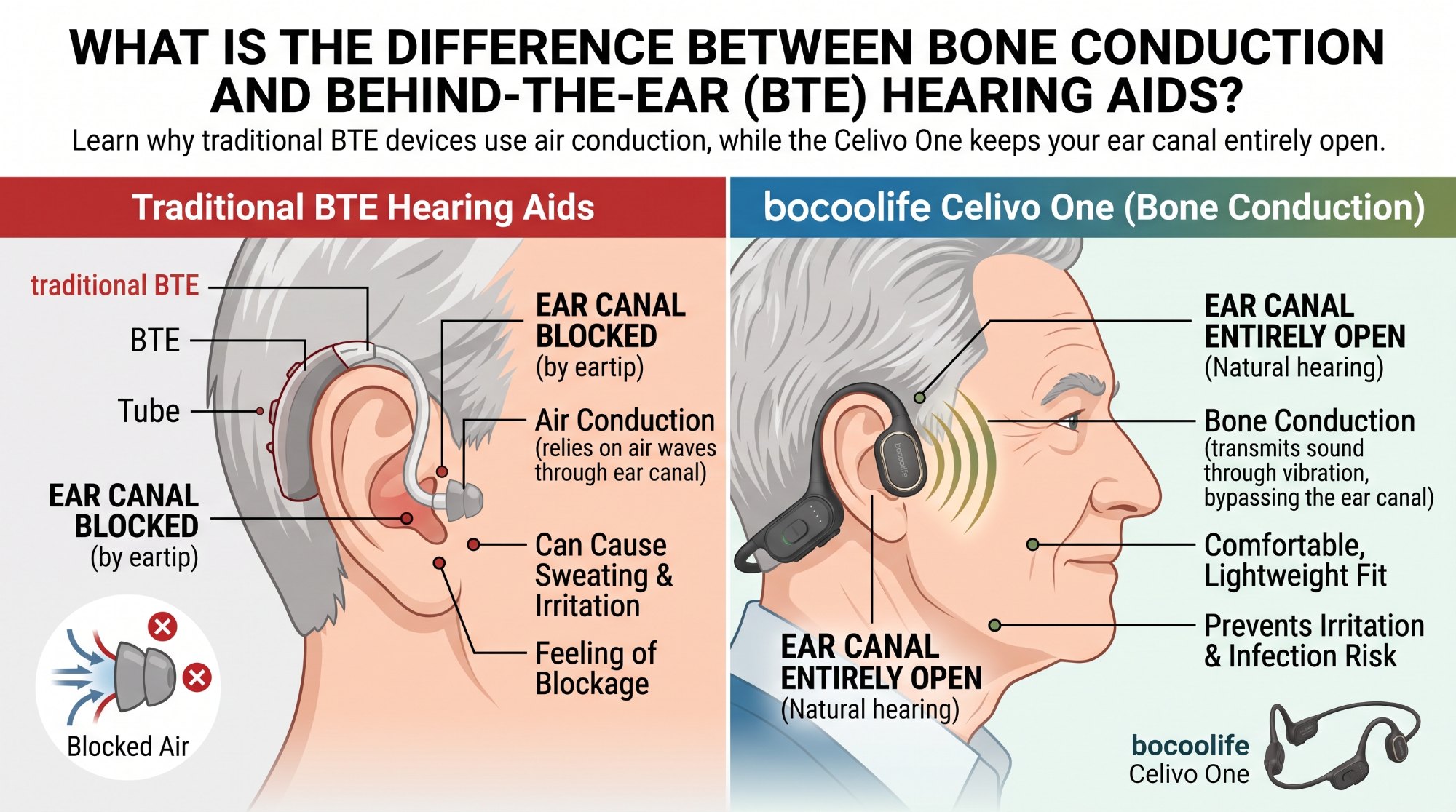
What is the difference between bone conduction and behind-the-ear hearing aids? Most traditional behind-the-ear (BTE) devices are air-conduction tools that use a tube or wire to push amplified sound through a speaker into your ear canal. In contrast, the bocoolife Celivo One is an open-ear bone conduction hearing assistant that sends sound directly to your inner ear through gentle bone vibration. It completely bypasses your ear canal and eardrum, leaving your ears open, naturally ventilated, and comfortable.
Understanding Traditional Behind-the-Ear (BTE) Air Conduction
Behind-the-ear hearing aids are one of the most common styles available today. In a standard BTE configuration, the main electronic housing rests behind the ear, and sound travels through a thin tube or wire to an ear dome or custom mold seated inside the ear canal.
Because these devices rely on air conduction, they must direct sound waves through the air to vibrate the eardrum. To deliver sufficient amplification without acoustic feedback (whistling), the ear tip typically needs a snug fit within the canal.
For many daily users, having an object blocking the canal for long hours leads to common physical complaints:
* Canal Soreness: Continuous friction against sensitive ear tissue can cause tenderness by the end of the day.
* Moisture and Warmth: An obstructed canal restricts air circulation, trapping humidity and heat.
* The Occlusion Effect: Plugging the ear canal causes your own voice, chewing, and footsteps to echo boomy and hollow inside your head.
How Celivo One Bypasses the Ear Canal and Eardrum
The bocoolife Celivo One open-ear bone conduction hearing assistant approaches daily listening from an entirely different mechanical path.
Instead of generating sound waves in the air, the device rests comfortably on your cheekbone. It transmits acoustic energy through micro-vibrations directly to the cochlea (inner ear):
- Zero Canal Contact: Nothing is placed inside your ear canal. Your ears remain completely unblocked, allowing natural airflow throughout the day.
- Bypassing the Eardrum: Because sound travels through bone conduction rather than the eardrum, it offers an alternative pathway for people who find canal insertion uncomfortable.
- Natural Spatial Awareness: Because your ear canal is wide open, you hear the sounds around you—such as family members talking, background music, or doorbells—in a completely natural way while receiving clear speech support.
- Personalized Dual-Ear Control: Unlike basic devices with fixed curves, Celivo One pairs with a dedicated smartphone app that allows independent left and right ear frequency adjustments for a balanced listening experience.
Side-by-Side Comparison
| Feature | Behind-the-Ear (BTE) Air Conduction | bocoolife Celivo One (Open-Ear Bone Conduction) |
|---|---|---|
| Sound Mechanism | Air-conduction speaker directs sound into the canal | Bone vibration transmits sound to the inner ear |
| Ear Canal Placement | Requires an ear tip, dome, or mold inside the canal | Zero insertion; rests outside on the cheekbone |
| Acoustic Pathway | Travels down the canal and vibrates the eardrum | Bypasses the ear canal and eardrum entirely |
| Ear Ventilation | Obstructed; traps heat and moisture | 100% open; naturally ventilated |
| Ambient Connection | Often muffles natural environmental sounds | Full, natural awareness of surrounding sounds |
| Independent Adjustment | Often requires in-clinic programming | Independent Left/Right ear tuning via mobile app |
Choosing between traditional BTE air conduction and modern open-ear bone conduction comes down to personal comfort and how you prefer to experience the world around you. If you dislike having your ears plugged, bone conduction provides a comfortable, open-wear alternative for daily communication.