How Do Bone Conduction Hearing Aids Work?
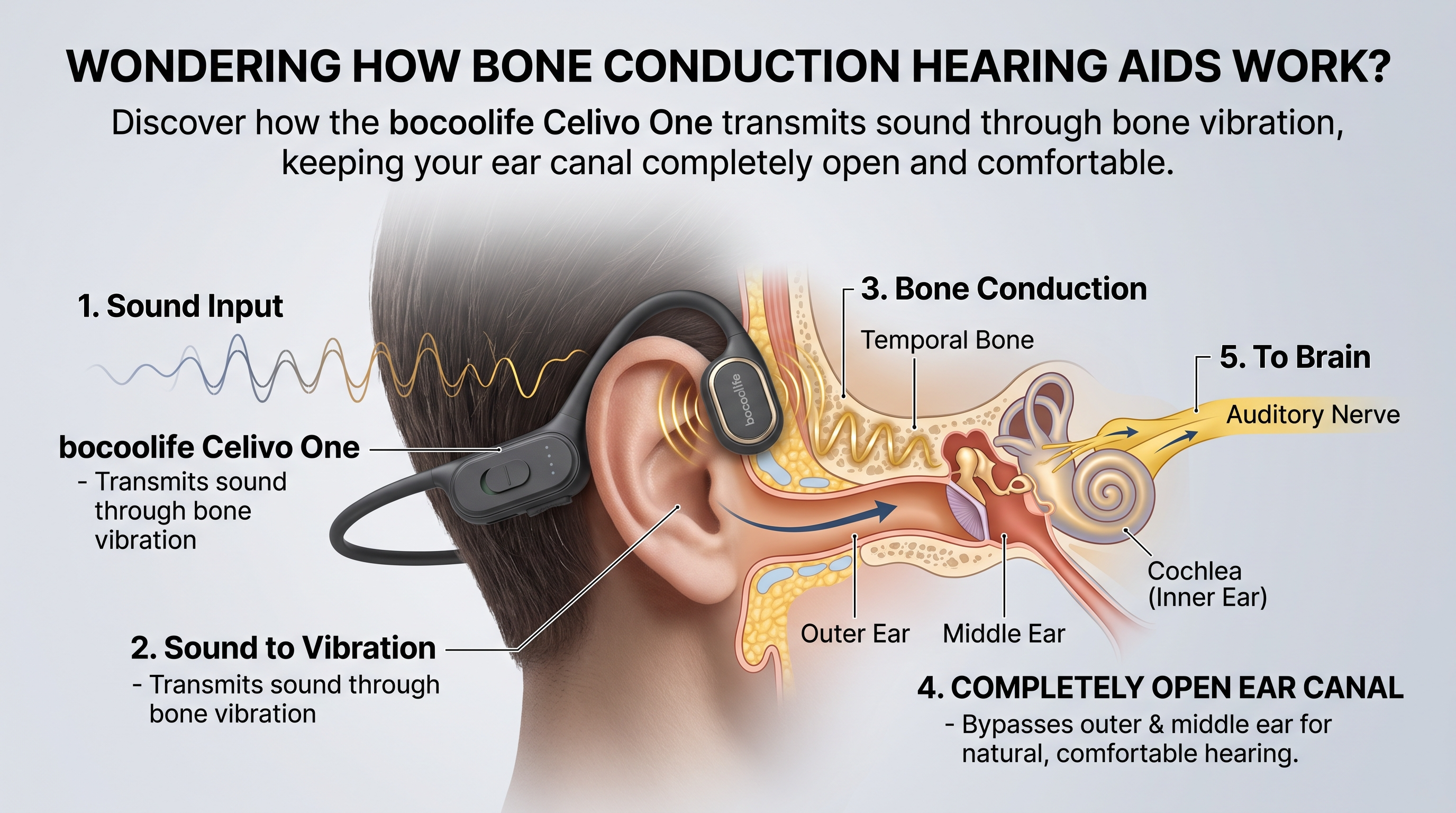
How does the bocoolife Celivo One send sound without blocking your ears? Instead of using a traditional air-conduction speaker that plugs your ear, it transmits sound directly through bone vibration. This mechanism sends clear audio through your cheekbones straight to your inner ear. As a result, your ear canal remains completely open. It is not an air-conduction device, meaning you can hear conversations clearly while still feeling fully connected to your natural environment.
Bone Conduction vs. In-Ear Air Conduction
To understand why this matters, it helps to compare bone conduction with traditional in-ear air conduction.
Standard hearing devices rely on air conduction. They sit inside your ear canal and act like tiny loudspeakers, pushing amplified sound waves through the air toward your eardrum. Because they need to trap the air to work effectively, they require a tight seal. This blocks your ear canal, which can lead to a "plugged up" feeling, trapped moisture, and physical fatigue after hours of wear.
Bone conduction hearing aids, like the Celivo One, take an entirely different path. By resting gently on the outside of your head, they bypass the eardrum and the ear canal altogether.
The Benefits of an Open Ear Canal
Because the Celivo One uses bone vibration instead of an air-conduction speaker, you experience several daily benefits:
* True Comfort: There is nothing squeezed into your ear, eliminating the soreness and physical pressure associated with standard ear tips.
* Natural Awareness: Your ear canal is completely unblocked, allowing you to hear ambient sounds—like approaching cars or a ringing phone—naturally.
* No "Echo" Effect: It prevents the occlusion effect, which is that annoying booming sound of your own chewing or breathing that often happens when your ears are plugged.
By rethinking how sound is delivered, the Celivo One provides a dignified, comfortable way to stay in the conversation all day long.