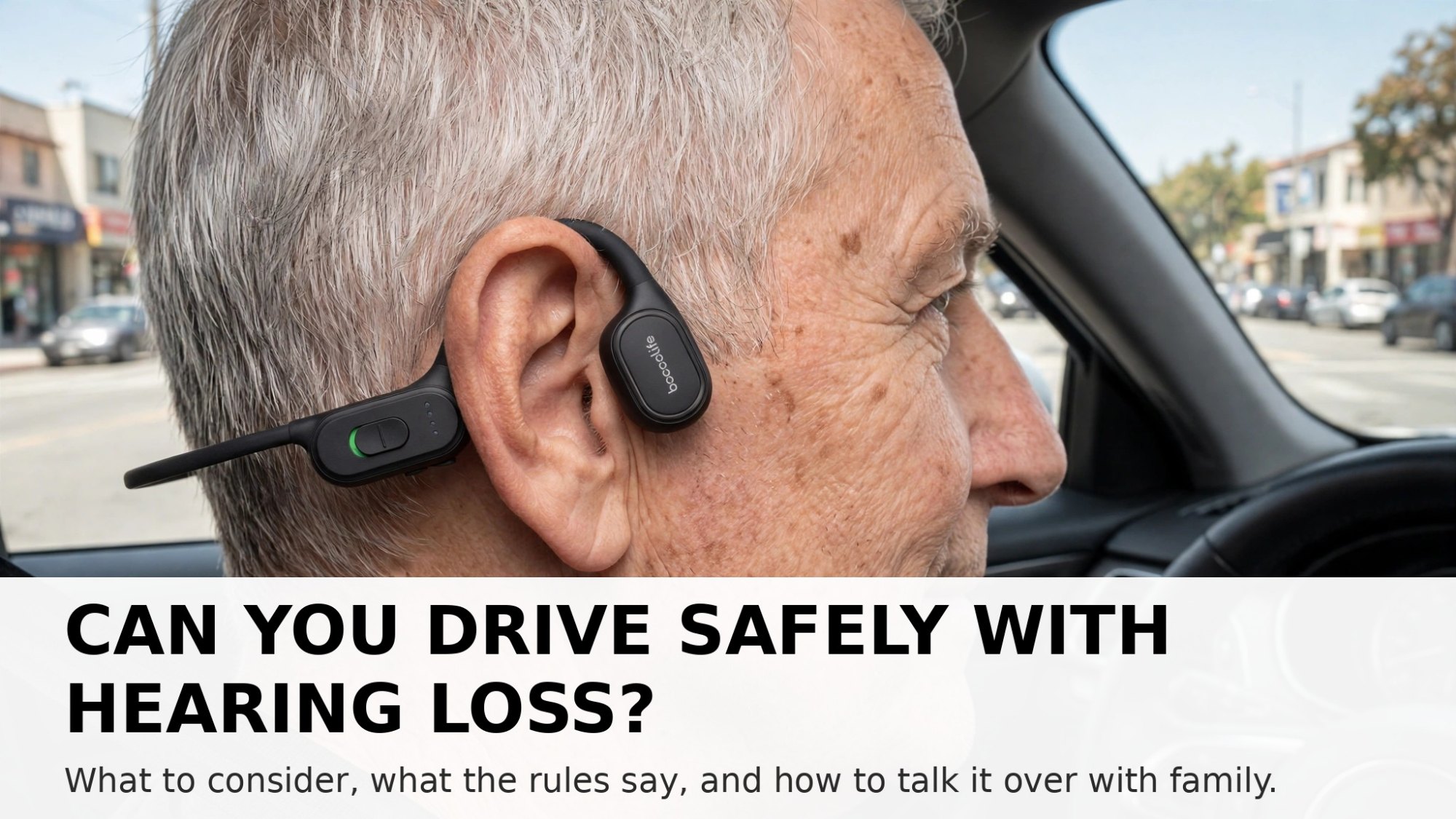
Driving with hearing loss can be harder, because sirens, horns and navigation prompts are easy to miss when road noise covers them. An Open-ear bone conduction Hearing Assistant can help by lifting speech and warning sounds: sound is transmitted through bone vibration, the ear canal stays completely open, and it is not an air-conduction speaker, so traffic sounds around you stay audible while voices come through more clearly.
What Driving Asks of Your Hearing
Driving is mostly a visual task, and many people with hearing loss drive for years without a problem. But hearing still plays a real part. It warns you about things you cannot see yet, and it carries the small spoken details of a journey.
- Warning sounds arrive before the sight. A siren or a horn can reach you before the vehicle appears in a mirror.
- Passengers give directions out loud. A simple "turn left here" is easy to miss when road noise fills the car.
- Navigation prompts are spoken, not just shown. A missed prompt can mean a missed turn, and a missed turn can mean a stressful detour.
- The car itself talks to you. A turn-signal click, a seat-belt reminder or an unusual engine sound all carry information.
The Sounds That Are Easiest to Miss
Not every sound fades at the same rate. The ones that tend to go first on the road are often the high, light or distant ones:
- Sirens from far away. A distant siren is soft and high, and it can be covered by wind, tyres and the engine.
- A horn in heavy traffic. In a noisy street, a single horn can blend into the general hum.
- A passenger speaking softly. Conversation in a car competes with road noise, and a quiet voice can disappear into it.
- Navigation prompts at low volume. If the voice guidance is set quietly, a single instruction can pass unnoticed.
Missing one of these now and then is normal for anyone. Missing them often, or feeling unsure about what is happening around the car, is worth paying attention to.
Habits That Help Behind the Wheel
Small changes to how you drive can make a meaningful difference, with or without any device:
- Scan your mirrors more often. Many drivers with hearing loss rely more on mirrors and on watching the flow of traffic, and that visual habit is a genuine strength.
- Keep the radio and the road in balance. A loud radio can cover the sounds you need. Turning it down, or off in busy traffic, leaves more room for warning sounds.
- Plan the route before you set off. Knowing the turns in advance means a missed navigation prompt is less likely to cause a problem.
- Ask a passenger to be a second pair of eyes. A companion can watch for flashing lights and repeat directions when the road is noisy.
- Avoid phone calls while driving. A call takes attention away from the road and from the sounds around the car.
If you are unsure whether driving is right for you, talk it over with your family and follow the rules where you live. That conversation is part of staying safe, not a sign of failure.
How an Open-ear bone conduction Hearing Assistant Fits a Drive
A listening option for the road needs to do two things at once: lift the sounds you need, and leave the sounds around you alone.
- Warning sounds stay audible. Because sound is transmitted through bone vibration and the ear canal stays completely open, sirens, horns and traffic noise still reach you directly.
- Speech stands out against road noise. The 300Hz–3kHz vocal enhancement focuses on the range where most speech lives, so a passenger's directions or a navigation prompt can come through more clearly.
- Volume is easy to adjust without looking down. The large physical +/- buttons let you turn the sound up or down by touch, keeping your eyes on the road.
- Each ear can be set to its own needs. With the app, left and right ears can be tuned independently, and the at-home hearing test helps you find a starting point that suits you.
- It is made for long days out. A single charge gives up to about 10 hours of use, and USB-C charging takes about 50 minutes.
Comfort varies from person to person, and a new way of listening can take a little time to get used to. Trying it first on short, familiar trips can help you find settings that feel right before a longer journey.
Stay in the conversation, on the road and off it.