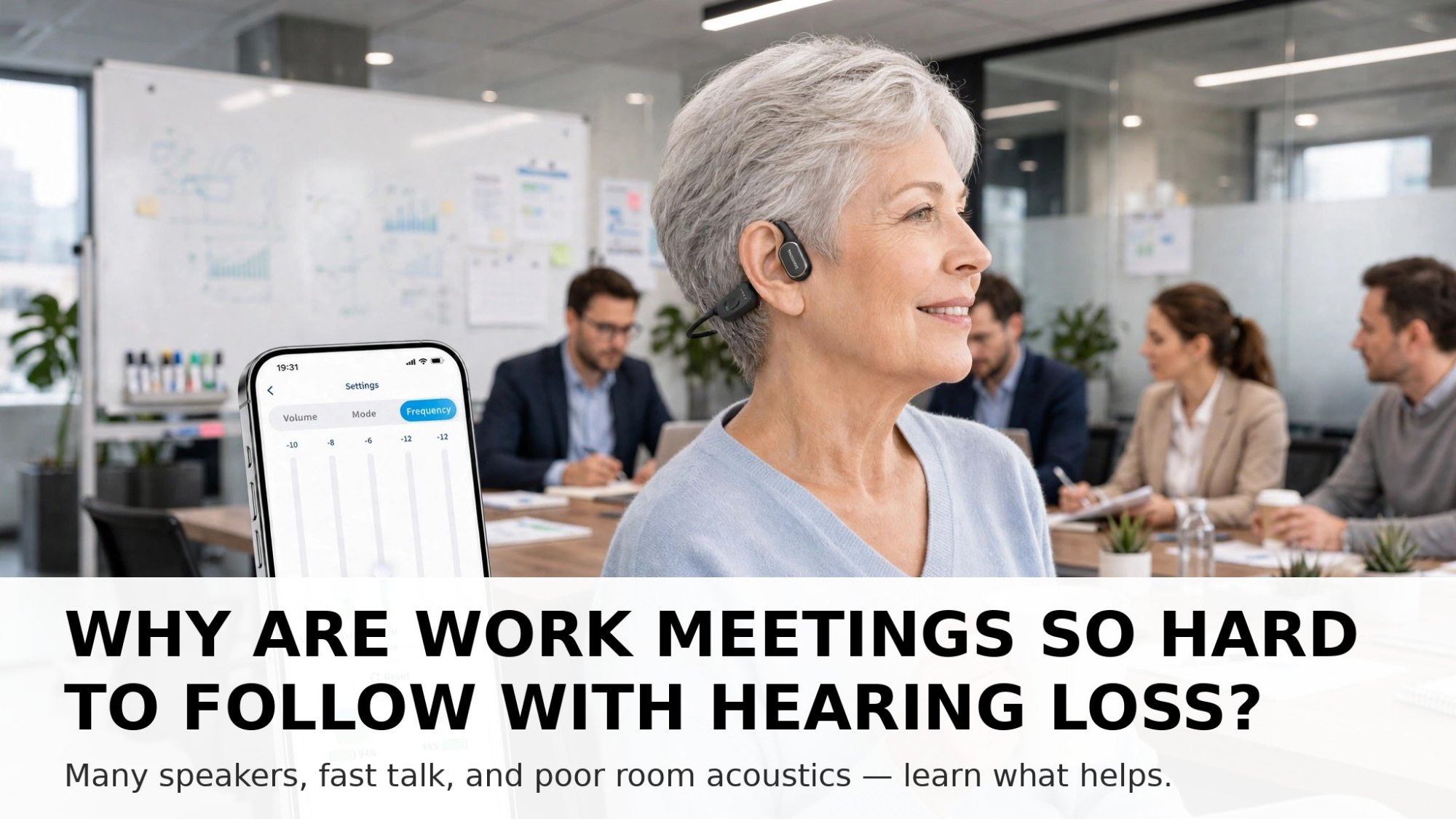
Work meetings are hard to follow with hearing loss because several people talk at once, voices come from different directions, and there is little time to ask for a repeat. An Open-ear bone conduction Hearing Assistant can help by lifting speech toward your hearing: sound is transmitted through bone vibration, the ear canal stays completely open, and it is not an air-conduction speaker, so the room around you stays audible while voices come through more clearly.
Why Meetings Are Harder Than a One-to-One Chat
A conversation with one person is manageable for most people. A meeting is a different kind of listening altogether:
- Several people speak at once. Side conversations, interruptions and quick back-and-forth exchanges overlap, and the voice you need can disappear into the mix.
- Voices come from every direction. The person speaking may be across the table, behind you, or at the far end of the room.
- There are no captions. Unlike a video call, a face-to-face meeting offers no text to fall back on.
- The pace is fast. A decision can be made in a few quick exchanges, and by the time you have worked out one sentence, the discussion has moved on.
- You cannot pause the room. Asking everyone to slow down feels awkward, so many people simply nod along and catch up later.
Listening Fatigue Is Real
One of the most common experiences people describe is not just missing words, but feeling exhausted by the effort of keeping up.
- Concentration has a cost. Following a meeting with hearing loss takes active, focused effort, in a way that easy listening does not.
- The tiredness builds up. A morning of meetings can leave you drained by lunchtime, even if the work itself was not heavy.
- Breaks are not laziness. A short pause between meetings, a quiet walk, or a few minutes away from the noise can help you recover enough to listen well again.
- Hiding the effort makes it worse. Pretending to follow along takes energy too, and it often means missing the very points you needed to hear.
If meetings leave you tired in this way, it is not a personal failing. It is a sign that the listening load is high, and that some support could help.
Small Changes That Help at Work
A few practical adjustments can make meetings noticeably easier, with or without any device:
- Sit where you can see faces. A seat near the main speaker, with a clear view of the room, gives you visual clues to go with the sound.
- Ask for the agenda in advance. Knowing the topics beforehand means fewer surprises, and you can prepare for the words and names that will come up.
- Suggest one person speaking at a time. Many teams welcome this rule, because it makes meetings clearer for everyone, not just for you.
- Ask for written follow-ups. A short summary of decisions after the meeting catches anything you missed, and it helps the whole team stay aligned.
- Tell your colleagues. A simple, matter-of-fact word about your hearing can change how people speak to you — facing you, slowing down slightly, and checking that you heard the key point.
How an Open-ear bone conduction Hearing Assistant Fits a Meeting
For a workday full of meetings, a listening option needs to lift speech without cutting you off from the room.
- Speech stands out against background noise. The 300Hz–3kHz vocal enhancement focuses on the range where most speech lives, so voices can come through more clearly against shuffling papers and side conversations.
- The room stays open. Because sound is transmitted through bone vibration and the ear canal stays completely open, you can still hear the person beside you, a question from across the table, and the general atmosphere of the room.
- Volume is easy to adjust between speakers. The large physical +/- buttons let you turn the sound up or down by touch, without looking at a screen in the middle of a discussion.
- Each ear can be set to its own needs. With the app, left and right ears can be tuned independently, and the at-home hearing test helps you find a starting point that suits you.
- It is made for long days. A single charge gives up to about 10 hours of use, and USB-C charging takes about 50 minutes.
Comfort varies from person to person, and a new way of listening can take a little time to get used to. Trying it first in smaller, familiar meetings can help you find settings that feel right before a big one.
Stay in the conversation, in every meeting.