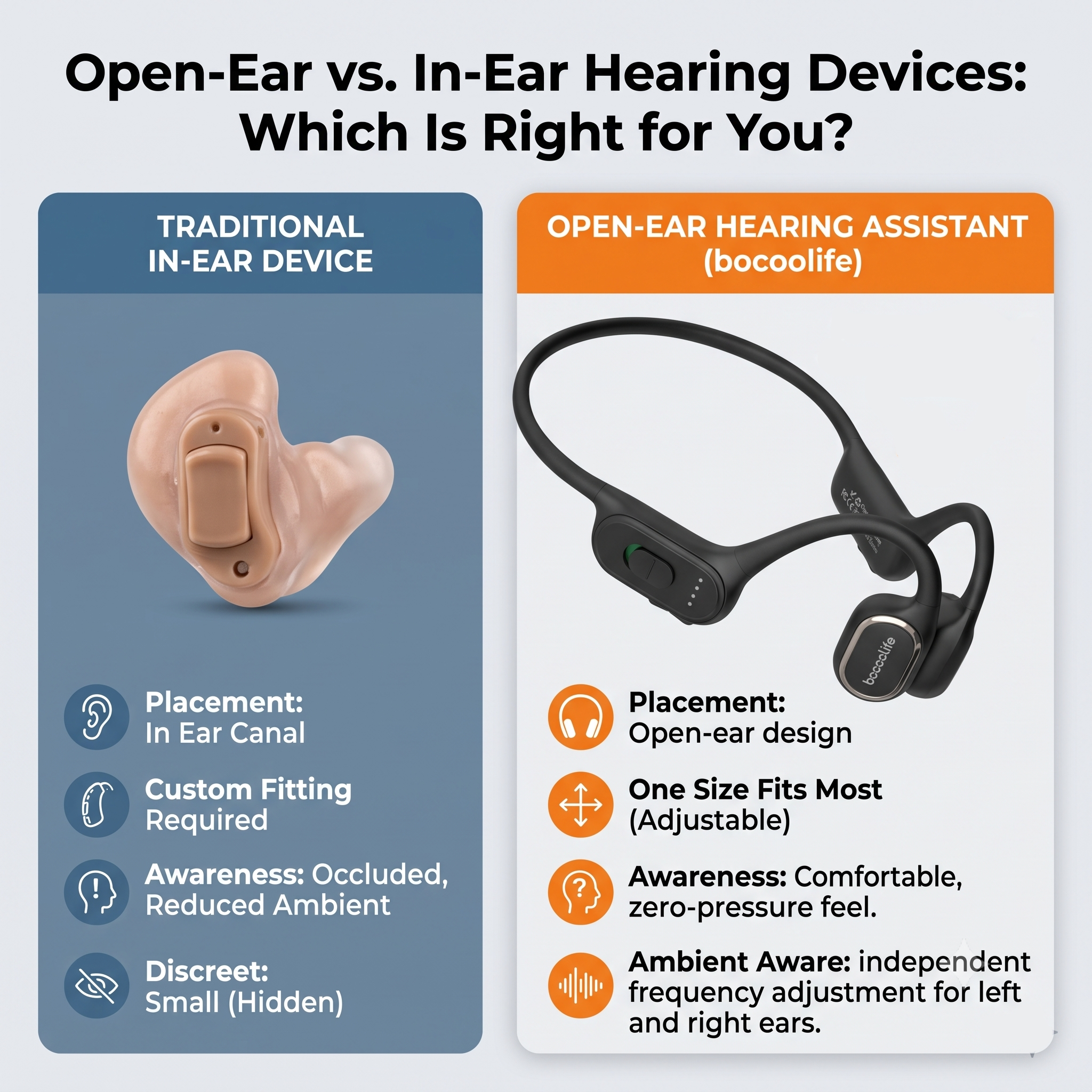
Two Different Ways to Deliver Sound
When you look for everyday hearing support, you will find two very different designs: traditional in-ear devices and open bone-conduction hearing assistants. bocoolife Celivo One is an open bone-conduction hearing assistant. Sound travels by bone vibration, and the ear canal stays open — it is not an air-conduction speaker. Standard in-ear devices work the other way: an air-conduction speaker sits inside the ear canal and pushes sound toward the eardrum.
Knowing how each one works helps you choose a device you will actually keep wearing.
The In-Ear, Air-Conduction Approach
Traditional in-ear devices, including many conventional hearing aids and personal amplifiers, are made to fit snugly inside the ear canal. To deliver amplified sound, they usually rely on a close seal.
That brings familiar trade-offs. Pressure against the skin of the canal can feel sore after a few hours. A sealed canal can trap warmth and moisture, which some people find stuffy. A plugged ear can also cause the "occlusion effect" — your own voice, chewing and breathing sound louder and boomier than usual.
How Open Bone Conduction Differs
An open bone-conduction hearing assistant like Celivo One takes a different path. Nothing is inserted into the ear canal; the device sits outside it.
Sound reaches the inner ear by bone vibration, so the ear canal stays open. In daily use, that means:
- Nothing inside the canal: No in-canal pressure or trapped moisture — a good fit for people who dislike having something in their ears.
- You still hear your surroundings: Because the canal is not sealed, you keep hearing doorbells, traffic and family members in the next room.
- Voices without the plugged feeling: Clearer everyday conversation without the muffled, echoing sensation of a blocked ear.
Side-by-Side Comparison
| Feature | In-Ear Air Conduction | bocoolife Celivo One (Open Bone Conduction) |
|---|---|---|
| Sound pathway | Air vibration directed at the eardrum | Bone vibration to the inner ear |
| Placement | Inserted into the ear canal | Sits outside the ear canal |
| Ear canal feeling | Can feel plugged, warm or moist | Stays open and ventilated |
| Surrounding sound | Often muffled | Still audible, because the canal is not sealed |
| Occlusion effect | Common (boomy own voice) | Avoided, because the canal stays open |
| Left/right settings | Often one shared setting | Separate hearing compensation for each ear in the app |
Choosing What Fits Your Day
If you would rather keep your ear canals open and stay connected to the people and sounds around you, an open bone-conduction hearing assistant is worth considering. Comfort and results vary from person to person, which is why Celivo One comes with a 30-day money-back guarantee and free returns.