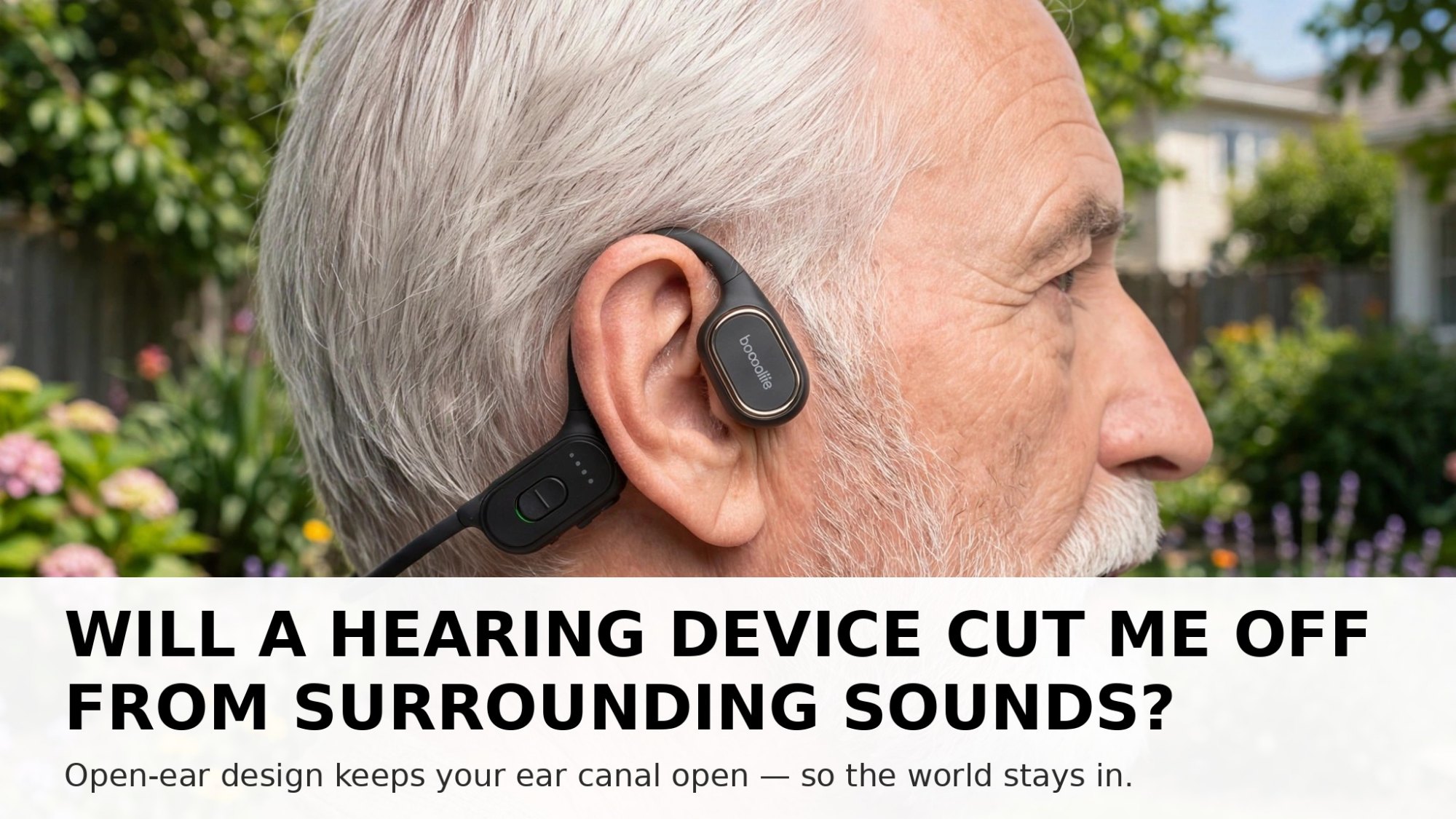
Will a Hearing Device Cut Me Off from Surrounding Sounds?
Will a hearing device cut you off from surrounding sounds? It depends on the design. Devices that seal the ear canal block natural sound along with the noise — but an open-ear design does the opposite. The bocoolife Celivo One, an open-ear bone conduction hearing assistant, transmits sound through bone vibration with your ear canal open — not an air-conduction speaker — so doorbells, traffic, and voices around you still reach your ears naturally.
The Fear Behind the Question
This is one of the most common worries among first-time buyers, and it is a reasonable one. You want voices to be clearer — but you do not want to feel sealed off from the world. You still want to hear the doorbell, the kettle, a family member calling your name from another room, or a car approaching when you cross the street. A device that trades one problem for another is not a solution.
Why Sealed Designs Feel Cut Off
Traditional in-ear devices work by plugging the ear canal. That tight seal is how they push amplified sound toward the eardrum — but it also blocks the natural sound that would otherwise reach your ears. The result is a familiar set of complaints: your own voice sounds hollow and boomy inside your head, the room feels muffled and distant, and you lose the casual awareness of what is happening around you. Many people describe it as feeling "underwater" for the whole day.
How Open-Ear Bone Conduction Keeps You Connected
An open-ear bone conduction hearing assistant works on a completely different principle. Instead of pushing sound through a sealed canal, the bocoolife Celivo One rests on your cheekbone and sends gentle vibrations through the bone directly to your inner ear:
- Enhanced speech, natural surroundings — at the same time: The device emphasizes the 300Hz–3kHz speech range, while your ear canals stay completely open. That means the voices you want to follow come forward, and everyday sounds — a doorbell, a phone ringing, traffic, a grandchild's question — still reach your ears the way they always have.
- No occlusion effect: Because nothing is wedged into the canal, your own voice doesn't echo boomy inside your head.
- Awareness that matters for safety: Staying connected to surrounding sound is not just about comfort. Hearing a car, a bicycle bell, or someone calling out is part of moving through the day confidently.
Finding Your Balance
Everyone's balance between speech and surroundings is personal. Some people want voices pushed further forward; others prefer a lighter touch. The companion app lets you tune the left and right ears independently and adjust the balance gradually, and the physical + / − / M buttons let you fine-tune volume by touch in the moment. Give yourself a few days in different situations — at home, outdoors, in a shop — to find the balance that feels most natural to you.
A good hearing device should not ask you to choose between hearing people and hearing the world. With an open-ear design, you don't have to.