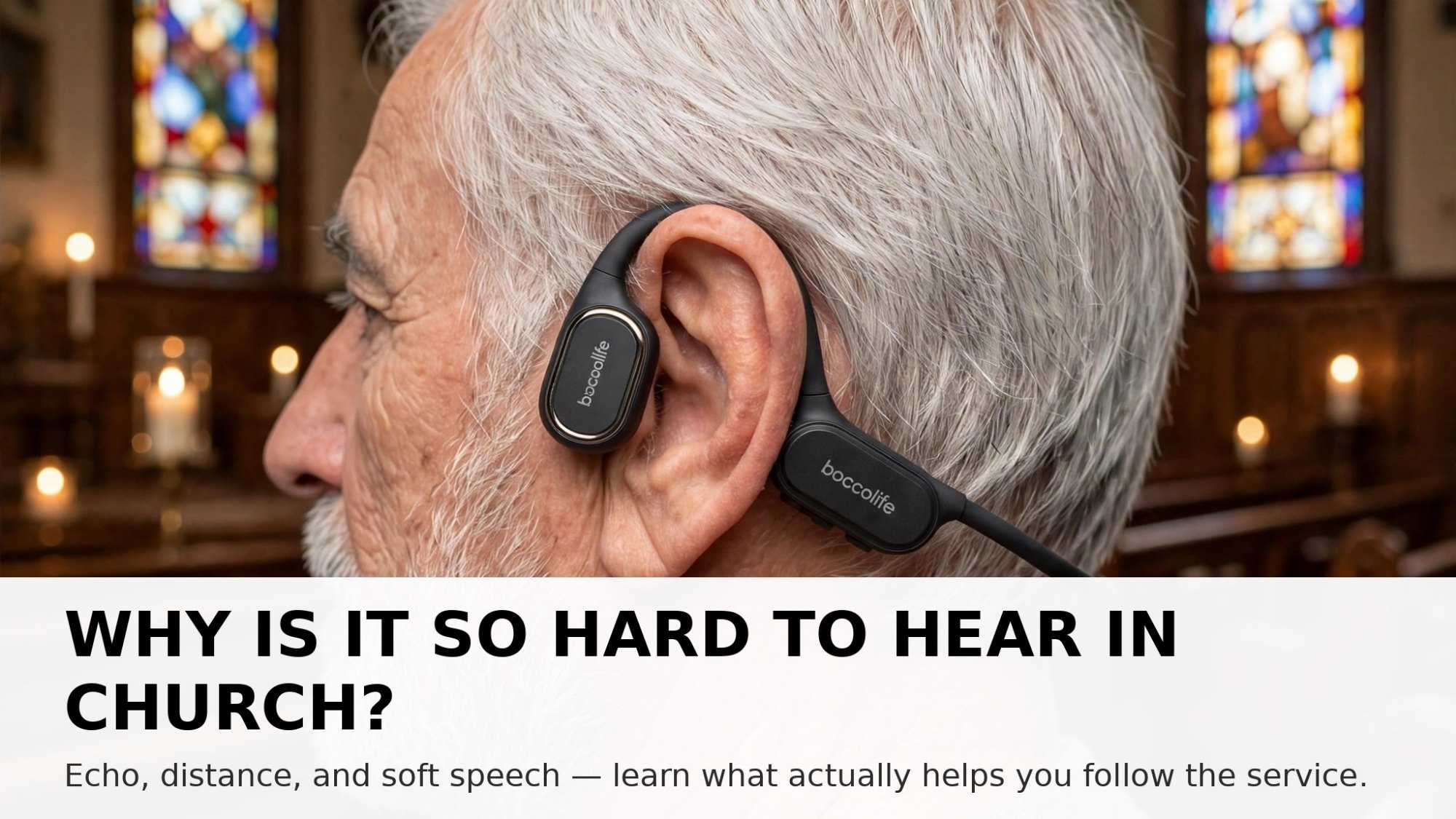
Church is hard to hear in because large halls create echo, distance weakens speech, and music often overlaps the sermon. An Open-ear bone conduction Hearing Assistant can help by sending the speaker's voice more clearly toward your hearing: sound is transmitted through bone vibration, the ear canal stays completely open, and it is not an air-conduction speaker, so surrounding sound still reaches you naturally.
Why Church Acoustics Work Against Clear Hearing
A church is built for music and for a feeling of space, not for easy speech. High ceilings, stone walls and wooden floors all reflect sound, so each word arrives at your ears more than once — the direct sound, then its echo a moment later. When those copies overlap, consonants blur and words run together.
- Echo stretches each word. A short word can linger in the air long enough to collide with the next one.
- Hard surfaces reflect, soft rooms absorb. A living room with curtains and carpet is far kinder to speech than a bare hall.
- The larger the space, the longer the sound hangs around. In a small room the echo dies quickly; in a church it can linger.
What Makes It Harder Than an Everyday Conversation
It is not just the building. Several things about a service stack up at once:
- Distance from the speaker. Sound grows weaker as it travels, and a seat at the back can be far from the pulpit or lectern.
- Music and speech overlap. Hymns, organ and choir are part of the service, but they can cover the softer sounds of spoken words.
- Different voices, different volumes. A sermon, a reading and a prayer may each be delivered at a different pace and volume.
- No chance to ask for a repeat. In a conversation you can lean in or ask someone to say it again. During a service, the moment passes.
Small Steps That Can Help During the Service
A few practical choices can make a real difference before any device is involved:
- Sit closer to the speaker. Even a few rows forward can reduce echo and distance at the same time.
- Arrive a little early. Choosing your seat calmly beats settling for whatever is left.
- Follow along with the printed order of service. Reading the words while they are spoken gives your ears a second clue.
- Ask a family member to whisper the key points. A short summary after a reading can keep you connected to the thread.
How an Open-ear bone conduction Hearing Assistant Fits Into a Service
For many people, the missing piece is a listening option that lifts speech without sealing off the room around them.
- Speech comes through, the room stays open. Because sound is transmitted through bone vibration and the ear canal stays completely open, you can still hear the music, the people around you and the atmosphere of the service.
- Human voices are given priority. The 300Hz–3kHz vocal enhancement focuses on the range where most speech lives, so words stand out more clearly against background sound.
- Volume is easy to adjust in the moment. The large physical +/- buttons let you turn the sound up or down quietly during the service, without looking at a screen.
- Each ear can be set to its own needs. With the app, left and right ears can be tuned independently, and the at-home hearing test helps you find a starting point that suits you.
- It is made to last through a long morning. A single charge gives up to about 10 hours of use, and USB-C charging takes about 50 minutes.
Comfort varies from person to person, and a new way of listening can take a little time to get used to. Wearing it for short periods at home first can help you find settings that feel right before Sunday.
Stay in the conversation, wherever you worship.